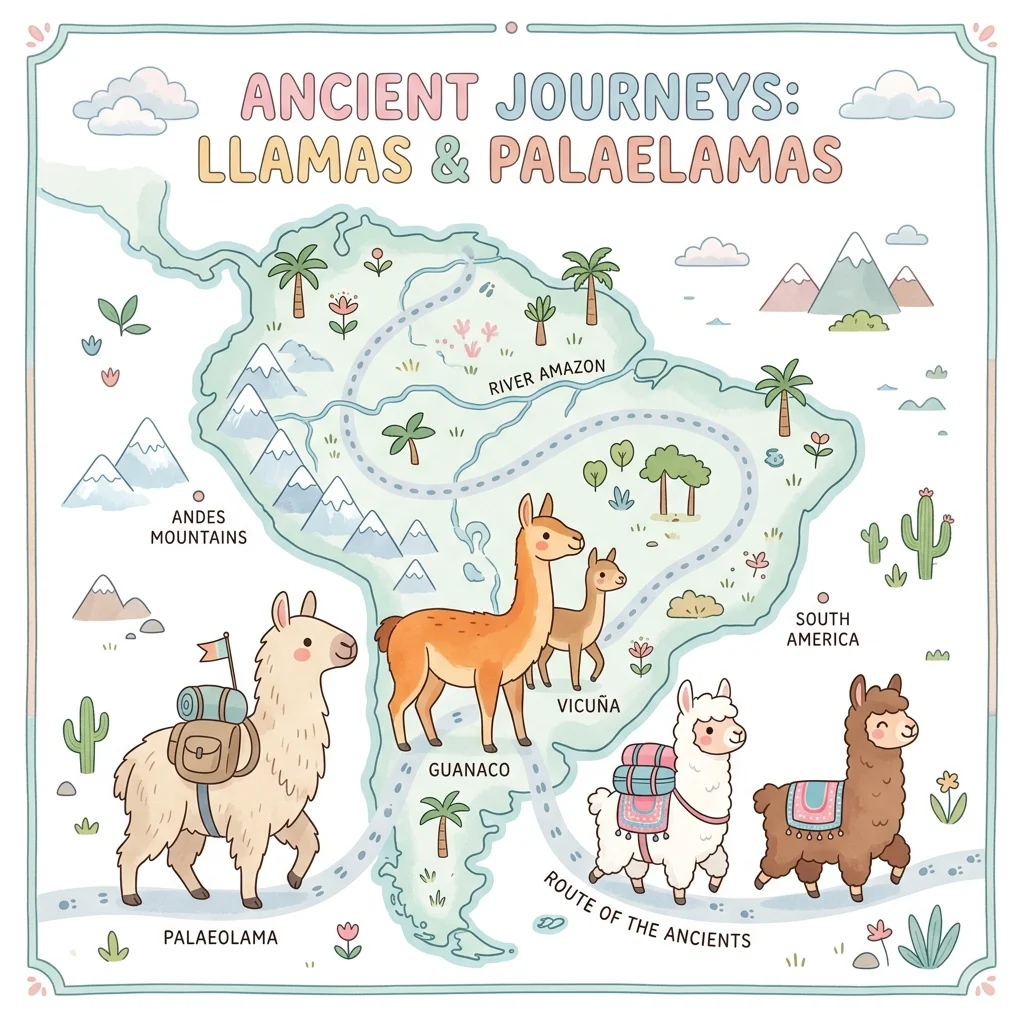
Camelid Evolution: 40 Million Years of History
The complete history of camelid evolution: from North American origins 40 million years ago to the Andean domestication of llamas and alpacas.
Camelid evolution spans an astonishing 40 million years, a remarkable journey that began in the vast grasslands of North America long before these animals ever set foot on Andean soil. Understanding this deep history helps us truly appreciate just how extraordinary modern llamas and alpacas are.
The first known camelid was the Protylopus, a small, rabbit-sized creature that roamed North America roughly 40 million years ago during the Eocene epoch. Over millions of years, these early camelids diversified into dozens of species of varying sizes, all confined exclusively to the North American continent. They walked on two toes, a trait faithfully preserved in today's llamas, and gradually evolved longer necks, larger bodies, and increasingly efficient digestive systems well-suited to grazing and browsing.
Around 3 million years ago, during the Pliocene epoch, a pivotal geological event changed the course of history: the formation of the Isthmus of Panama. This created a vital land bridge connecting North and South America. During what is known as the Great American Biotic Interchange, a branch of camelids successfully crossed southward into South America. This group eventually gave rise to the four distinctive species we know today: llamas, alpacas, guanacos, and vicuñas.
Fascinatingly, another branch of the camelid family journeyed in the opposite direction. They crossed the Bering land bridge into Asia and eventually reached Africa, evolving into the Old World camels we recognize today, the single-humped dromedary and the double-humped Bactrian camel.
Once established in South America, the camelids diversified into two wild species perfectly adapted to the varied terrain: the guanaco (Lama guanicoe) and the vicuña (Vicugna vicugna). From these two robust ancestors, early Andean peoples achieved successful domestication approximately 6,000 to 7,000 years ago in the high plateaus of present-day Peru and Bolivia. The guanaco was domesticated to become the llama, primarily used as a hardy pack animal, while the vicuña was domesticated into the alpaca, bred specifically for its fine, luxurious fleece.
Paradoxically, camelids disappeared entirely from their original homeland of North America around 10,000 years ago, near the end of the Pleistocene epoch. The exact causes of this mass die-off remain a subject of debate among paleontologists, but scientists generally point to a deadly combination of factors: rapid, severe climate warming that drastically altered the ecosystems they depended upon, coupled with intense hunting pressure from the newly arrived human populations.
This extinction event wiped out more than 70% of North America's megafauna in a relatively short period, taking with it mastodons, mammoths, and wild horses. The fact that horses also went completely extinct in the Americas during this same period, remaining absent until they were reintroduced by European explorers in the 15th century, puts the staggering scale of that faunal collapse into perspective. The camelid family survived this catastrophe solely because vital branches of their lineage had already emigrated and established themselves on other continents.
Life above 3,500 meters imposed very specific and brutal evolutionary pressures on Andean camelids. To survive on the freezing, oxygen-deprived puna highlands, they developed a suite of remarkable biological adaptations:
- Elliptical red blood cells: Unlike typical placental mammals, which possess round blood cells, llamas have oval-shaped erythrocytes. This shape allows the cells to navigate capillaries more smoothly and capture oxygen far more efficiently in thin-air atmospheres.
- High-affinity hemoglobin: Their hemoglobin binds oxygen up to 25% more effectively than that of lowland mammals. This incredible efficiency allows them to sustain intense physical activity at altitudes that would completely incapacitate an unacclimatized human being.
- Padded feet: Instead of hard hooves, their feet end in two toes equipped with soft, leathery pads. This allows them to traverse sharp, rocky terrain securely without damaging or eroding the fragile mountain ground, offering a major ecological advantage over hooved animals like horses or cattle.
- Double-layer thermoregulation: Their double-coated fleece features a fine, insulating inner fiber and a coarser, weather-repelling outer fiber. This acts as a highly advanced natural insulator, keeping them warm during the freezing Andean nights (which can drop to -15°C) and protecting their skin from the intense, burning solar radiation during the day.
For ancient Andean cultures, llamas were far more than mere domestic animals, they were the absolute backbone of both the economy and spiritual life. The Incas organized massive logistics networks using caravans of thousands of llamas, known as tropas. These caravans transported crucial goods such as salt, dried maize, intricate textiles, and precious metals across the Qhapaq Ñan, the astonishing Andean road network that stretched more than 30,000 kilometers. Historical estimates suggest that the Inca Empire controlled and directly managed more than 50 million camelids at its peak.
Llamas also held a deeply central ritual role. They were frequently sacrificed in grand ceremonies dedicated to the sun god Inti, and their entrails were meticulously examined by priests to read omens and predict agricultural outcomes. The significant archaeological discovery of ritually sacrificed llamas at Huanchaquito in Peru, where more than 200 young individuals were found carefully and ceremonially buried, provides stark physical evidence confirming the massive scale and importance of these religious practices.
Today, there are approximately 3.5 million llamas in the world, with populations concentrated predominantly in Bolivia, Peru, and Argentina.
The conservation story of their wild cousins is one of dramatic recovery. The species that has caused the most concern historically is the wild vicuña. Hunted ruthlessly and almost to extinction during the 20th century for its extraordinarily fine fiber, the global vicuña population plummeted to a mere 6,000 individuals by the 1960s.
Thanks to decisive action by the Convention on International Trade in Endangered Species (CITES), which listed the vicuña in Appendix I in 1975 and banned all commercial trade, alongside aggressive recovery programs driven by the governments of Argentina, Bolivia, Chile, and Peru, the population has rebounded spectacularly. Today, there are more than 350,000 wild individuals, and the species is now classified as "Least Concern" on the IUCN Red List. Their highly sought-after fiber may now only be commercialized under strictly regulated, humane community management schemes (the traditional chakus).
The guanaco faces a more complex, modern challenge. Although its total population still comfortably exceeds one million individuals across South America, increasing pressure from domestic sheep farming and severe habitat fragmentation have drastically reduced its historical grazing ranges.
South American camelids represent a premier economic and cultural resource for rural Andean communities. Their sustainable fiber, lean meat, and high-altitude endurance are increasingly valued in international markets as symbols of ethical, sustainable, and high-performance agriculture.
Simultaneously, there is growing interest in Europe and North America in raising llamas and alpacas. It is estimated that there are over 40,000 llamas registered in the UK, around 15,000 in Germany, and thousands more across North America and Spain, where they are cherished as companion animals, eco-friendly land clearers, and therapy animals. This global expansion closes, in a profoundly poetic sense, the historical circle: after millions of years, these remarkable animals are returning to the continents where their evolutionary story first began. They stand today as the final, thriving result of one of the most successful and resilient evolutionary experiments on the planet.
TodoLlamas Team
Passionate about Andean culture and the world of camelids. Our mission is to research and share the most curious information about llamas.